Product · Technical documentation
DocLynks
Author once, publish many — a manual as a versioned build output.
Our role
Product design · Desktop application · Render pipeline · Data model
Platforms
Windows desktop · Local SQLite · Fully offline
Timeline
Delivered · v1.1.3
Overview
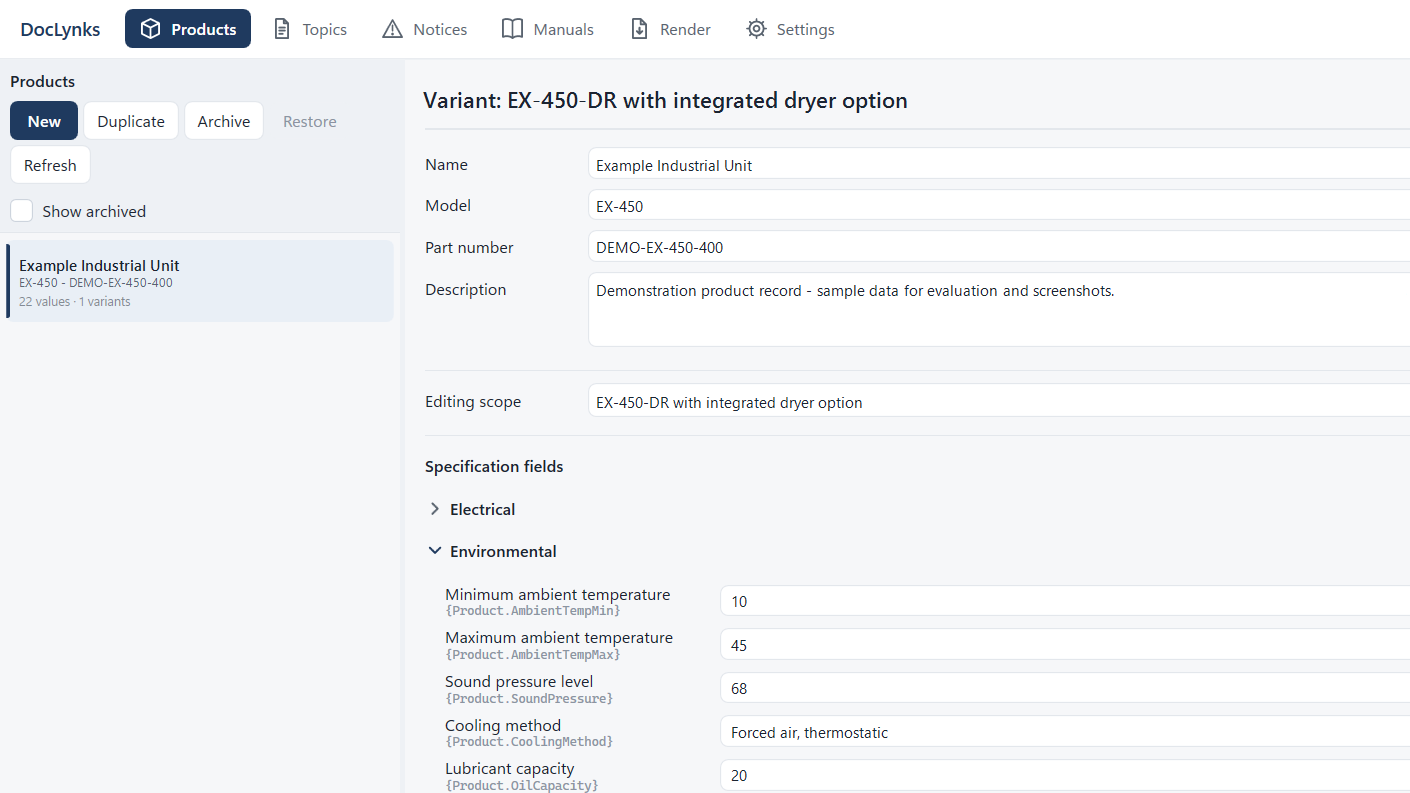
DocLynks treats a product manual not as a word-processing document but as a build output: a structured, versioned PDF generated on demand from product data, reusable content and a template. Specification values live in the product record and are pulled into topics through placeholders resolved at render time; topics and safety notices are written once and referenced, never copied. Change a supply voltage or a warning and every manual that references it is updated on its next render. All data sits in a single local SQLite file — there is no cloud dependency and the workflow runs fully offline.
The challenge
Copy-paste is where the defects are born
When a manual is assembled by hand, a stale voltage rating or a missing warning can survive into print. In a compliance document that is a liability, and it comes directly from duplicating content instead of referencing it.
A gap on the page looks deliberate
A missing specification value rendered as blank space reads as intentional to whoever is holding the manual, so the omission is never questioned.
Our approach
One content pool, referenced not copied
Topics, safety notices, specification values, branding and translations each live in one place and are referenced by every manual that needs them — so a manual cannot quietly disagree with the product record.
Fail the render, never the document
An unresolved placeholder is a hard error that blocks the render. Every attempt returns a full validation report with severities and a jump-to-source button, so the whole work list arrives at once rather than one error at a time.
Deterministic output, so a manual is auditable
Rendering is a pure function of the manual revision, product data, template and language: the same inputs produce a byte-identical PDF, and the result summary reports the output's SHA-256.
Key features
Single-source authoring
Topics, notices and specification values written once and referenced by every manual and language variant.
Structured product records
Specification fields and groups, variants and overrides, a standards register and a Declaration of Conformity generator.
Safety notices & symbols
A central notice library with five signal levels, plus bundled IEC/ISO safety symbols and custom ones.
82079-1 starter structures
Manuals can be built from an IEC/IEEE 82079-1 aligned skeleton rather than a blank page.
Localisation with honest fallback
Per-language rendering, with untranslated content either blocking the render or shown in the source language behind a visible marker.
Word import
Turns an existing .docx manual into structured topics, flagging what was inferred and needs review.
Validation report
Errors, warnings and information in one pass, with a jump straight to the offending token.
Deterministic PDF
Byte-identical re-render from unchanged inputs, with a SHA-256 of the output.
Screens
Byte-identical
Deterministic re-render
Offline
Local SQLite, no cloud
v1.1.3
Shipped Windows installer
Built with
Building something like DocLynks?
We take products from idea to launch — securely, end to end. Let's talk about yours.
Start your project